

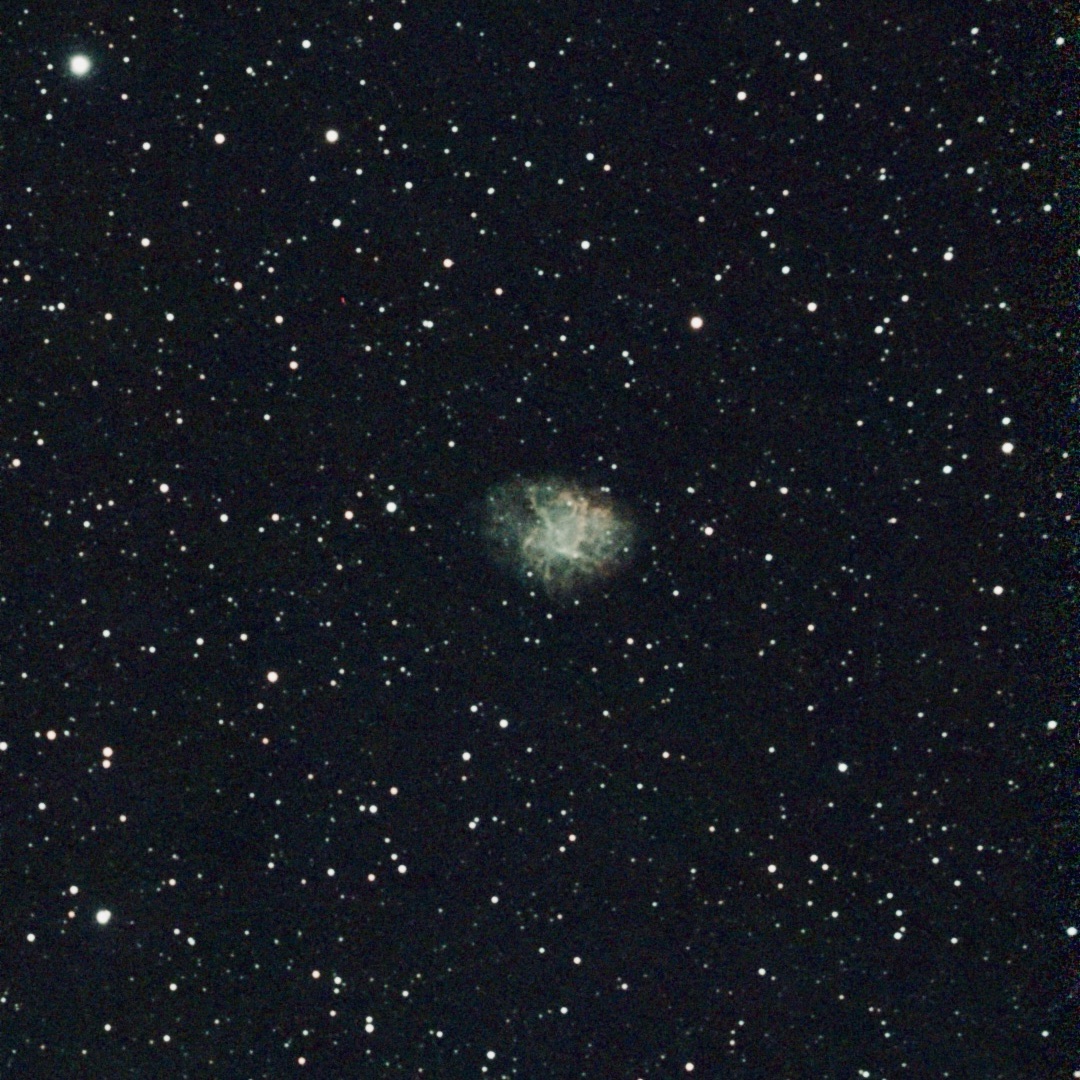
Crab Nebula: Deep Space Objects from Every Angle
It’s early autumn here in the States. Nights are getting cooler, and darker for longer. And I’m taking advantage of clear, still evenings to plot a few hours course around the skies and see what there is to be seen.
More and more, I’m recording a lot of those sights with a clever little tool I picked up in February. The Seestar S50, from ZWO, received glowing reviews from sources I trust and completely turned my head around from being a visual-astronomy-only devotee.
Here, in an easy-to-use package, was the answer to countless morning-after questions from family and friends on “what did you see last night?” Now, I could set up a separate camera scope alongside my trusty Celestron NextStar 8SE, instead of fiddling with rigs to attach my phone over top of the eyepiece, and have the best of both worlds: astrophotography and all the objects I could spot with my own eyes.
So I plan my stargazing sessions in two ways:
1. Mapping out all the constellations from East to South to West to North I can hop around to with the big scope over the course of a few hours, slewing to each star and double-star, squinting at the usually fuzzy but sometimes discernable deep sky nebulae and galaxies and other faraway, dim stuff.
2. Listing the Deep Sky objects whose light the Seestar can soak up over the course of multiple, automatically-stacked 10-second exposures, gradually resolving, digitally, what my eyes could never see from my usually light-blasted suburban backyard.
This method has only deepened my appreciation for the array of tiny double stars my visual scope can split with its 8″ objective lens and a tray full of eyepieces of varying resolution, as well as the ability of the big C8 to bring planets — and their moons! — up close. While at the same, the Seestar has the potential to reel in every item on Charles Messier’s famous catalog, from the M1 Crab Nebula through the M110 elliptical galaxy floating just beyond big Andromeda (M31) — and all the star clusters and asterisms and galaxies in between.
Seestar helps you collect for yourself some of the same waypoints of the universe immortalized by Hubble, or James Webb; or that I’d only virtually visited in games like Space Engine, or Nasa’s virtual tools.
Which gave me an idea, and way to share my Seestar tour stops as a recurring feature on this blog.


Here’s Lookin’ at You, Crab Nebula
Most of my research before a stargazing session is on what objects I can see, in which part of the sky, at what time of night. It’s sometimes while I’m scoping them that I might hit the INFO button on my big scope’s hand control for a quick fact about them, but more than likely it’s the next morning, as I review my logs and photos from the night before, that I pore over books like John Reed’s 110 Things to See with a Telescope, or Turn Left at Orion, and learn all the fascinating details about our vast, galactic neighborhood.
In that same continuing spirit of discovery, I found myself looking up on Space Engine the same deep sky objects I’d scoped with the Seestar and exploring them in three additional ways:
- Here: From the same basic angle I’d seen them on Earth — northern hemisphere near South Dakota, but nostalgically, usually during Christmastime 1985, when I would have been about 9 and Halley’s Comet was last streaking nearby
- There: From space after “flying” to the object to capture it, in high resolution, closer up than even Hubble or James Webb
- In my Chair: Constructing a scenario that can only be lived through Space Engine: like, viewing a star cluster from a planet inside the cluster; or the Andromeda Galaxy as it rises above the horizon of a moon on a planet in neighboring galaxy M32.
So with any stargazing object of focus I can experience it with my naked eye, the light sucked in and processed by my camera, or the pure flights of fantasy enabled by the wonders of computer programming. Not too shabby a way to enjoy a hobby!


THERE: M1, the Crab Nebula, 6,500 Light Years Closer
In the case of M1, the Crab Nebula, famous first entry on Messier’s list, you’re looking at the remnants of a supernova first observed by Chinese astronomers in 1054 AD. For a few months that year the exploding star glowed bright enough to be seen from Earth during the day.
Some 1,000 years later what we’re seeing are the filaments of colored gas that are stirred by the still raging solar wind of the dying neutron star, or pulsar, at the center of the nebula.
Today, the neutron remnant emits radiation from every end of the light spectrum, from X-rays through visible light to Gamma rays. But in a few thousands years the visible nebula will be gone, and all that will be left of the star that blew up long ago will be the radio-wave-emitting pulsar.
If all that seems a bit “over your head” to process, have a look at the pics I generated from Space Engine, traveling 6,500 light years from Earth to visit the Crab Nebula up close, then landing on a planet 11 light years away to capture the much-larger view of the Nebula in the sky — as well as the Milky Way — just after sunset (and at a latitude on that planet where the sun rises again a mere 3 hours later).
Last look: a view from near the neutron star itself. We don’t want to get too close, as neutron stars are the next-densest thing in space next to black holes, but from outside its borders we can see the nebulous filaments of green and red and surrounding space.
Not a bad way to experience M1. Where to, next? Stay tuned for more “Here, There and in My Chair!”

 Dadsense